BRIEF HISTORY
The first High Commissioner of India, Sir William S. Meyer, was appointed on 1 October
1920. At that time four buildings were rented at Grosvenor Gardens in Victoria to
accommodate the office of the High Commission. Sir Atul Chatterjee, who became the High
Commissioner in 1925, proposed a plan to build a House for the High Commission to the
Governor General Lord Reading and the proposal was subsequently approved by the Governor
General Lord Irwin. A plot measuring 12,400 square feet was found between Marconi House
(now Citibank) and Bush House in Aldwych and a 999 years' lease was granted by the London
County Council for construction of the building. Sir Herbert Baker who built the
Secretariat Buildings and Parliament House in New Delhi was appointed the Chief Architect.
The building was completed in 1930 and, in a very impressive ceremony, King Emperor George
V opened the main gate of India House on 8 July 1930 with a solid gold key. The total cost
for the building, including furniture and fixtures, was 324,000.
SELECTION OF ARTISTS FOR PAINTING THE MURALS
The Government of India held an open competition in India for the selection of artists. A
high-powered committee selected out of eighty applicants, the following four Bengali
artists:
Lalit Mohan Sen (Lucknow)
Ranada Charan Ukil (Delhi)
Dhirendra Krishna Deb Barma (Shantiniketan)
Sudhansu Sekhar Choudhury (Kolkata)
They were sent to London in August 1929 and thereafter, to Florence, Rome and other cities
in Europe to learn the technique of painting on plaster. In London, they were trained by
Professor Sir William Rothenstein at the Royal College of Arts, Kensington. Queen Mary
herself met the artists at the Royal College and told them that she was eagerly looking
forward to see their paintings in India House.
Work started in a temporary studio set up in a room lit by a skylight on the top floor of
India House. It took the artists about ten months to complete their preparations. On 9
April 1931 the artists started painting. For technical reasons they decided to use
egg-tempera instead of oil. Egg-tempera colour is made by mixing powdered pigments with
yolk of egg and water.
THE MURALS
- Entrance Hall (Ground Floor)
In the entrance hall eight sections of pendentives were painted by R. Ukil and S.
Choudhury depicting the six seasons of India, at dusk and dawn.
Grishm (Summer, May/June)
Varsha (Monsoon, July/August)
Sharad (September/October)
Hemant (November/December)
Sheet (Winter, December/February)
Basant (Spring, March/April)
- Visitors Lounge/Reading Room (Exhibition Hall) - (Ground Floor)
Lunette 1: Anarkali by S. CHOUDHURY
The painting depicts Prince Salim (later Emperor Jehangir) mourning
over the grave of Anarkali, a slave girl with whom he had fallen in love. Anarkali means
pomegranate blossoms. She was very beautiful and had the delicate charm of this flower.
Lunette 2: Shasti Puja (Goddess of Progeny) by S. CHOUDHURY
The picture shows an elderly woman leading young women laden with offerings to the goddess
who sits under a banyan tree so that these young women may be blessed with children.
Lunette 3: End of Roza (FAST) by R. UKIL
A young girl is pointing out the new moon in the month of "Shawal"
to her aged father and telling him that he can now break his Roza (fast), as it is
the end of Ramzan. The Ramzan extends over a period of about 30 days and ends in the
festival of ld-ul-Fitr.
Lunette 4: Tordee Ragini by R. UKIL
Sadly, this is not visible as it is now covered
by wood panelling. The picture depicted the personification of a particular tune ('tordee')
playing on a string instrument called the Veena. Indian music is divided into two
groups comprising 'Ragas' and 'Raginis'. This particular Ragini is charming
the animals in the forest.
In Lunette 1 'Anarkali' and Lunette 2 'Shasti Puja' were over painted later with oil
colour and the effect of egg-tempera painting is lost.
- Octagonal Hall (Lobby on First Floor) Pendentives
D.K. Barma painted eight pendentives to depict
the eight phases of life where the columns and the scroll motifs are used to describe the
transitions from one phase to another.
I. Birth (Janma)
A mother sits with a child in her lap. The colour red symbolises the transformation of a
spirit into a human entity.
II. Childhood (Balyavastha)
A child plays with his toys. In this painting red gradually merges into orange to signify
the gradual development from the rawness of birth into human form and also the cheerful,
carefree existence of childhood.
III. Student Days (Vidyarthi Jeewan)
A boy is writing on a palm leaf. The colour scheme here changes to yellowish green from
orange to convey the idea of approaching youth. The scrollwork, though not yet floral in
design, conveys the idea of blossoming flowers - approaching spring.
IV. Love (Prem)
A girl is offering a lotus to her beloved. The green colour scheme refers to the fullness
of youth. The scrollwork now becomes fully floral.
V.Family Life (Grahstha)
A man with his wife and child. The colour scheme changes to greenish brown to suggest
maturity. The scrollwork also suggests maturity.
VI. Work (Karma)
The plough suggests the necessity of work. The axe conveys the idea of protection of the
family from danger. The colour scheme is now brown which suggests the autumn of life. The
scrollwork contains deer and monkeys to suggest the freedom of nature that is outside the
life of a family man.
VII. Renunciation (Van prastha)
The man renounces all earthly ties and turns his thoughts to religion and nature. Leaving
his home life behind, he goes to live in the forest. The brown colour scheme has now
changed into bluish grey. The scrollwork represents fire, in which can be seen burning the
desires of man - passion, anger, greed, pride, glory - of which he has recognised the
illusion.
VIII. Nirvana
Death in the form of a woman taking the spirit to its last life, i.e., the last birth into
eternal life. The colour scheme is blue for eternity.
- The Central Dome
The magnificent central dome is the most
dominant feature of the building. The murals on the dome depict four epochs in the history
of India merged in a harmonious whole. All four artists laboured for about ten months to
transform spectacular historical events into richly coloured murals. For the gold
background 24-carat gold leaves were used at the then staggering cost of nearly one
thousand rupees.
- Southern Quadrant by R. UKIL
The meeting of Alexander the great with the Indian King Porus after the
latter's defeat in a battle. Alexander asked Porus what treatment he expected; Porus asked
to be treated as one king would treat another. This bearing so pleased Alexander that he
returned his kingdom to Porus.
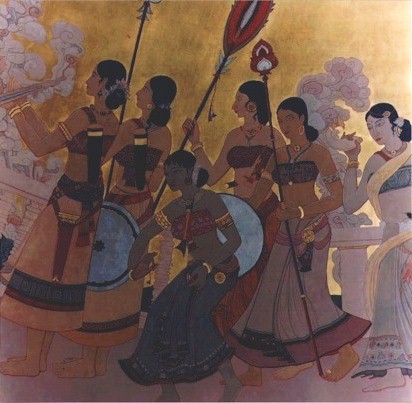
- Western Quadrant by S. CHOUDHURY
The great Mauryan Emperor, Chandra Gupta, receiving his morning salute
from his bodyguard of woman soldiers.
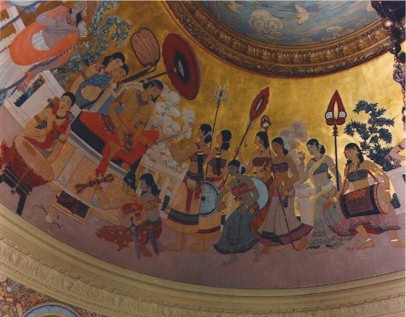
- Northern Quadrant by DK Deb Barma
Emperor Ashoka is sending his daughter Shangamitra to Singhal (Sri
Lanka) for preaching the teachings of the Buddha. Shangamitra is seen walking away with
her companions carrying a sapling of Bodhi tree and Buddhist scriptures, followed by a
group of musicians. Not far away Emperor Ashoka himself is reading Buddhist scriptures for
giving his blessings to Shangamitra.
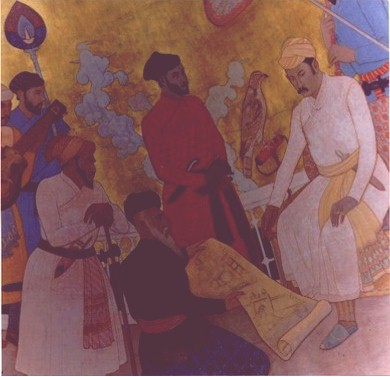
- Eastern Quadrant by L.M. SEN
The great Mughal Emperor Akbar is discussing with his architect the
plans of his new capital, Fatehpur Sikri. (See below)
The paintings of "Sky and Birds (Balaka)" on the coved
ring above the dome and the ceiling (at the base of the hanging lantern) were created
jointly by R. Ukil and S. Choudhury.
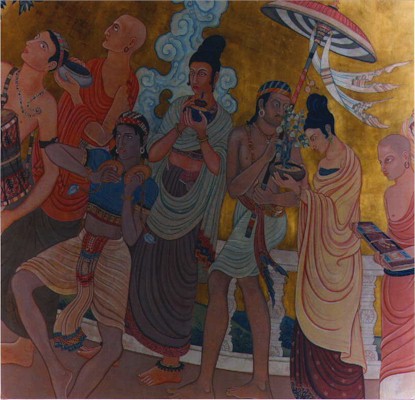
- Gandhi Hall (Library Hall)
Buddha with his Disciples by L.M. SEN
Gautama Buddha is asking his disciples, "who is going to take my place after my nirvana?"
All the disciples, save one, Anand, who is seen sitting at the feet of the Lord, raise
their begging bowls to offer to take charge of his mission. Anand who was the principal
disciple of Lord Buddha remains silent.
The painting of all the murals was completed in January 1932.
Addendum
The artists, in addition to board and lodging, received one pound
(rupees thirteen and eight anas) per day as remuneration.
King Emperor George V and Queen Mary visited India House again on 12
March 1932 especially to see the paintings.
Rabindranath Tagore visited India House in 1931 with Prof Rothenstein
to meet the artists. He was delighted to learn that all the subjects and themes selected
for the murals were typically Indian.
Sir Atul Chatterjee was the prime mover for creation of India House.
His ideas and guidance for selection of themes and subjects for the murals were much
valued by their artists. Sir Atul Chatterjee was born in 1874 and educated in Calcutta and
Cambridge universities. He joined Indian Civil Service (ICS) in 1896. He was High
Commissioner for about six years from 1925 to 1931. He then returned to India and was
appointed member of the Viceroy's Council. He spent his retirement in England and died on
September 1955 in his home at Bexhill-on-Sea.
When India gained Independence in August 1947, India House was
transferred to the Government of India and V.K. Krishna Menon was appointed High
Commissioner.
PROVINCIAL SYMBOLS
The floor of the entrance hall (Ground Floor) is enriched by
beautifully inlaid symbols of provinces arranged in a circle (similar to Zodiac circle)
with swastika at the centre. The symbols represent provinces as described below:
| (1) |
Fort St George |
Madras |
| (2) |
Ship |
Bombay |
| (3) |
Tigers |
Bengal |
| (4) |
Fishes, which to Hindus and Muslims alike
stand for good luck, and a bow and arrow referring to Rajput traditions. |
United Province of Agra and Oudh |
| (5) |
Five rivers with the sun shining above them |
Punjab |
| (6) |
Two snakes (nags) representing the
ancient Nag dynasty and the provincial capital of Nagpur. |
Central Provinces |
| (7) |
The Bodhi tree under which Gautama Buddha
reached salvation |
Madras |
| (8) |
Peacock |
Burma* |
| (9) |
Rhinoceros |
Assam |
| (10) |
Elephant in Procession |
Delhi |
| (11) |
Camel |
Baluchisthan |
| (12) |
Crescent moon over a Gateway |
North West Frontier Province |
*Burma was part of Indian Empire under British
Raj.
|