TRANSCRIPT OF PRESS CONFERENCE GIVEN BY THE PRIME MINISTER, MR TONY BLAIR, AND THE INDIAN PRIME MINISTER, MR MANMOHAN SINGH
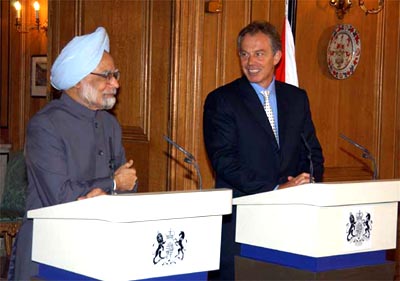
IN LONDON ON MONDAY, 20 SEPTEMBER 2004
TONY BLAIR, UK PRIME MINISTER :
Good Afternoon everyone. First of all can I say what an honour and a pleasure it is to have the Prime Minister of India with us today, and many thanks for coming here.
This is our first opportunity to meet after your successful election, and congratulations to you Sir. And perhaps as much for our own media here as anyone else, I think we should say that the relationship between Britain and India is probably the strongest it has been today for many, many years. It is a relationship that is actually going from strength to strength. I think there has been a lot of commitment on both sides to making it work and that commitment is a commitment obviously which is about trade and investment, science and technology, but it is also a commitment to try to work together in the international arena to solve the problems that the international environment and community has no option but to try and solve together. And we have already had discussions which have ranged over all the issues you would expect us to talk about. We are publishing a joint declaration today as well which shows how we can take this work further, but for people here of course, and there is an Indian community here of around about 1.3 million people in this country of Indian origin, it is a relationship that matters a tremendous amount, but it is also one I feel increasingly within the international community that matters too. We discussed the G8 for example, that comes up next year, where I indicated to the Prime Minister that our priorities would be around the question of Africa and climate change, and I hope very much we can find a way of involving India in that dialogue at that level too, because the contribution India can now make to all these issues in the international arena I think matters a very great deal, not just to my country but to Europe and to others too.
So many, many thanks for having come here on your way to the United Nations General Assembly. It is a very great pleasure to see you, and to give a special word of thanks as well for all the work that you have done as Finance Minister, but now as Prime Minister, in helping India make progress. We remember the period of time when you were the Finance Minister when you took some very tough decisions, difficult decisions, to reform and change your country and we are delighted that through your leadership now as Prime Minister that you are able to take this work forward.
MANMOHAN SINGH, INDIAN PRIME MINISTER :
Thank you very much Prime Minister. It is for me a truly sentimental visit to Britain. I was mentioning to the Prime Minister that 50 years ago I came here as a student and had a look at 10 Downing Street from outside. Now I am here as the Prime Minister of India and the guest of my esteemed friend, Prime Minister Blair. Well that is an indication of how things have changed in our two countries. In 50 years Britain has changed a great deal, it is now a functioning multi-ethnic, multi-cultural, multi-religious society. This is what we in India are, and what we are trying to do in India is to build on our diversity a cohesive nation. We are trying to deal with the ancient scourge of poverty, ignorance and disease, using the instrumentalities of democracy, full respect for fundamental human rights, a deep and abiding commitment to the rule of law, and in that sense I explained to the Honourable Prime Minister that the Indian experiment of democracy and development is of worldwide significance.
In recent years the Indian economy has grown handsomely. In the last 10 years or so we have had an average growth rate of 06% per annum. It is our ambition to do better, and I am confident that with the support of Britain and other friends in the international community, we can succeed in achieving that goal. In the last 5 or 6 years that Prime Minister Blair has been associated with the management of affairs of this great country, we have received great cooperation from the British government and the British people. Indo-British relations are at an all time peak. But as I mentioned to the Prime Minister we cannot be satisfied with the status quo. We must try to do better and I do believe that there are opportunities. I am very grateful to the Prime Minister for having agreed to use this occasion to issue a joint declaration. That declaration sets out a vision, a strategy and a programme of action for our two nations and for our two governments to work together to realise our shared goals of a peaceful secure world, a world which will have the resources and time to devote to fighting the ancient scourge of mass poverty which still afflicts millions and millions of our people.
India and the United Kingdom have been partners in this struggle for the last 55 years. We in our country recall with gratitude that we are the largest recipient of British aid, and today British aid goes to areas which have a direct bearing on the fight against poverty. We believe the international trading system, other multilateral regimes have an important role to play in managing the increasing global interdependence of the world economy, and in that too I mentioned to the Prime Minister that our two countries, working together, can help to promote the cause of multilateral cooperation. But all this presumes that we have effective and credible strategies to deal with new problems created by international terrorism, we need credible bilateral, regional and multilateral approaches to deal with this menace of terrorism which today constitutes a threat to civilised society all over the world. In that way the fight against terrorism is truly a global effort, and I mentioned to the Prime Minister that we want to be a part of that coalition to fight against terrorism. We in our own sub-continent have experienced what terrorism can do to disrupt the lives of ordinary people, and therefore concerted strategies are needed to deal with this menace.
We had a brief discussion about Indo-Pakistan relations, and I reported to the Prime Minister the outcome of the comprehensive dialogue that we and Pakistan have had on the composite dialogue which was agreed to in January 2004. It is our sincere desire to carry forward that process, provided of course that the threat posed by terrorist elements can be kept under control, because if terrorism is not under control it will be very difficult for our countries to prepare Indian public opinion to move forward on the road to the dialogue. But if terrorism is under control, we would be more than willing to discuss all outstanding issues between our two countries. In this I found the Prime Minister fully supportive of our stand.
I also discussed with the Prime Minister the issue of India's permanent membership of the Security Council and I was very glad to have from him a reaffirmation of the United Kingdom's resolve to help India gain permanent membership of the Security Council.
QUESTION:
Prime Minister, Prime Minister Singh has mentioned the menace of terrorism. I wonder what you had asked him for in terms of help in Iraq; and secondly, whether you feel that an increase in international forces, given the weakness of the indigenous forces so far, is required if elections are to take place. And Prime Minister Singh, I wondered whether I could ask you, the menace of terrorism, do you see the war in Iraq as a war against terrorism, and if so, at what point will India join that particular conflict?
TONY BLAIR, UK PRIME MINISTER :
We actually will have an opportunity to discuss Iraq and indeed Afghanistan over lunch together. I don't think the issue is actually about getting more foreign troops into Iraq, I think the issue is primarily one of building up the capability of the Iraqi security forces, and that capability is being built up. It is going to take, however, some time, and we have simply got to stay with it and see it through and help them to do the job that they want to do. And I think it is worth just pointing out that for example in a place like Najaf, once it was actually freed of terrorists and those who were trying to disturb the local population, that the local population now is able to get on with its job of rebuilding the country. And that is why I said yesterday, whatever differences people have over the original decision to go to war and the conflict, I think that it is important to recognise now that what is happening there is an absolute battle between those who want democracy in Iraq to take root and to flourish, and those who want to prevent it. And on that issue I think there is only one side to be, as I said earlier.
MANMOHAN SINGH, INDIAN PRIME MINISTER :
Let me say that stability, restoration of normalcy and peace in Iraq is in the interests of the entire world community. We of course have our own perceptions of what is happening in Iraq, and also we have to look at the political consensus that exists in our countries. At the present time we are not in a position to commit Indian troops. However, we have offered to help retrain people from Iraq for humanitarian purposes, we can train their police, we can also provide rehabilitation and reconstruction assistance and for which we have already committed $30 million.
QUESTION:
My question is for Mr Blair. You spoke about cooperation in the international arena and our Prime Minister referred to the issue of the Security Council. So I just wondered if I could use this opportunity to get you to clarify, does Britain support reconstitution of the Security Council and do you believe that India should be a Permanent Member?
TONY BLAIR, UK PRIME MINISTER :
The answer to that is yes on both points, we do. India is a country of 1.2 billion people. For India not to be represented on the Security Council is something that is not in tune with the modern times in which we live. I also hope very much through the G8 process next year we can involve India, and indeed China too, in dialogue on important issues. There is no point for example on us having a dialogue on an issue like climate change, which is going to have an impact over the next few decades, without involving the Indian economy and the Chinese economy in that debate. So yes I think this is the position we have adopted over a long period of time and I have no doubt at all that as each year passes the case gets stronger.
QUESTION:
Prime Minister, could you say what efforts are being made today to free the British hostage in Iraq, Mr Bigley, and have you had any contact directly or indirectly with the kidnappers?
TONY BLAIR, UK PRIME MINISTER :
I am sorry, James, I think I have just got to camp on where I was yesterday. I don't think it is sensible for us to say anything at the present time, except to say obviously we are focused on doing what we can.
QUESTION:
Mr Prime Minister, when you have lunch with your counterpart, could you ask him to explain why it is politically correct for everybody to condemn terrorism, whatever the cause and justification, but when it comes to south Asia, the United States and Britain been seem to have taken a different and benign view of Pakistani-sponsored terrorism in Kashmir?
TONY BLAIR, UK PRIME MINISTER :
I can absolutely assure you of one thing, we do not have any equivocation about this at all. We totally and completely condemn any terrorism associated with Kashmir, as we do terrorism elsewhere in the world. And let's be quite clear about this, terrorists, whatever part of the world they are operating in, have no interest in peaceful solutions to problems, they simply want to divide people. Now the issue of Kashmir is being taken forward in the dialogue between India and Pakistan, a dialogue that the US and Britain have supported. But let's be quite clear, in supporting that, what we are supporting is a peaceful exchange of views. We are condemning totally and absolutely those people who go and kill the innocent, who try and murder elected politicians, because all that does is divide people. And I think it is worth just reflecting on this, because it is a reflection that it is right to make whenever one is in the presence of the Indian Prime Minister. India itself is an extraordinary example of a country that despite the problems of development it has to overcome, it is a democracy, as we have seen in recent months, a well functioning democracy, a country that is home to 150 ... Muslims as well as Hindus, and those of other religious and ethnic denominations, and yet the country is a country that operates on the basis of values of tolerance and respect for all. So I don't know where you get the idea that we are equivocal at all about terrorism in Kashmir, we totally condemn it, and the only way that there is going to be the basis of a solution there that lasts is through peaceful dialogue between India and Pakistan, which is why we support the present process.
QUESTION:
Given the hostage crisis and what General Sir Mike Jackson called the war of counter-insurgency, how far do you feel you have failed to heed the warnings about the aftermath of the war?
TONY BLAIR, UK PRIME MINISTER :
Well first of all, just to repeat what I said on Saturday, the actual warnings in the note that I was sent were warnings that it was important not to replace one dictator in Iraq with another, that is precisely why we have gone down the path of democracy. I know what has happened is that certain people have simply chosen to say the issue that has arisen today is the issue that there was some specific warning about. It is not correct, the actual issue was how we made sure that in removing Saddam Hussein with all the oppression and dictatorship that that represented, we didn't simply replace him with someone else, and that is a warning that of course we heeded and acted upon, which is why we have involved the United Nations. But let me just make it clear. Those people who are taking hostages, and not simply from countries incidentally that supported the war in Iraq, there are hostages that have been taken from countries who opposed the war in Iraq, but that is what indicates that what is happening now today is a conflict between those people who want to help Iraq on its feet as a stable democratic country, and who say the choice should not be for Iraqis one between a brutal dictator who killed hundreds of thousands of his people, and some form of religious fanaticism, but that there is another choice for Iraqi people, a choice that the Ministers here yesterday said they wanted, and that the people wanted, which is one in which they choose their government. And it is perhaps the right moment, standing alongside the world's greatest democracy, to say that many people I think did not believe that India, with all the problems of its development, could function as a democracy, and yet there it is, an absolute testament to the fact that whatever the problems of development, people anywhere in the world, given the chance, want to be democrats. Look at what is happening in Afghanistan at the moment. 10.3 million people have registered to vote, 40% of them women, despite the risk of assassination on the way to the polling booths. So of course these situations are terrible because of what is happening and because of the desire of these people to kill anyone who is trying to help that country get better, but our response has not got to be to weaken, our response has got to be to stand firm, to say whatever the differences about the Iraq conflict, there is a clear right and wrong on this issue, and that is to be with the democrats and against the terrorists.
QUESTION:
I have a question for you both. Prime Minister Singh, as you travel to the United Nations General Assembly, the Secretary General has called the Iraq invasion an illegal one, and as you stand next to Prime Minister Blair I wonder what thoughts you have on that a year after that invasion. And Prime Minister Blair, in the joint declaration today, of which we have seen an embargoed copy, there is a reference to India and the UK working together on civil nuclear cooperation. Do you have any thoughts on that?
MANMOHAN SINGH, INDIAN PRIME MINISTER :
As far as your question is concerned, I think our views are well known. There was a resolution passed by the Indian parliament, but what is more important is to look to the future rather than to delve into the past.
TONY BLAIR, UK PRIME MINISTER :
And in relation to the question of civil nuclear cooperation, we set out in the joint declaration how that can be taken forward, and I think it is important because of the importance of the issue that we work together and there is a scientific and technological expertise on either side that can be exchanged. So I think that will be another area of fruitful cooperation between us.
|